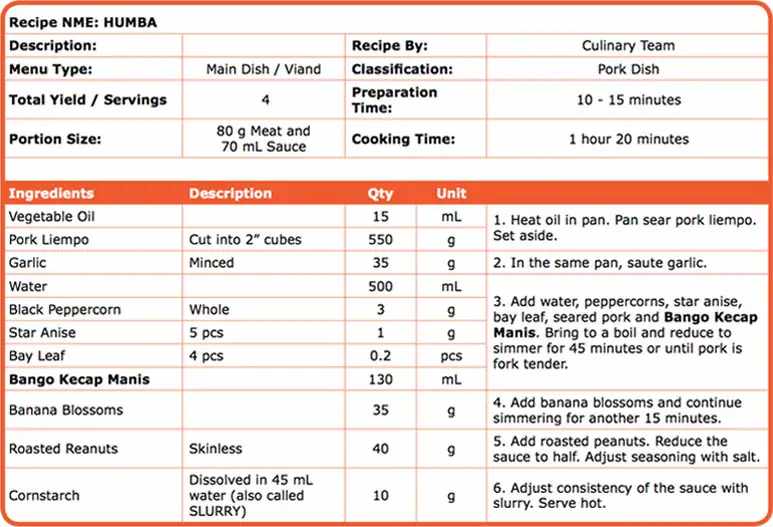
I used to think "serves 4" on a recipe meant something. Then I made a lasagna that was supposed to serve 6, and my family of 4 ate the whole thing with no leftovers. Then I made a soup that said serves 4, and it fed my family plus two extra guests with enough left for lunch the next day. That's when I realized that "servings" is basically a lie.
The problem is that nobody agrees on what a serving is. One person's serving of mac and cheese is a cup. Another person's is two cups. A restaurant might serve half a cup as a side. A hungry teenager might eat three cups. The word "serving" tells you nothing about the actual amount of food.
What you need is yield. Yield is the total amount the recipe produces. Measured in grams, ounces, cups, or volume. Not in vague people-units. A recipe that says "yield: 1,200 grams of cake, about 12 servings at 100 grams each" is precise. You know exactly how much cake you're making. You know how much each person gets. You can scale it without guessing.
I switched to yield-based recipes about five years ago. Every recipe I write now has a yield line first. "Yield: 8 cups of soup, about 6 servings." Or "Yield: 2,400 grams of cookie dough, about 60 cookies at 40 grams each." That clarity has saved me so many times.
Here's an example from my own kitchen. I have a chocolate chip cookie recipe that makes 24 cookies. But I don't call it a 24-cookie recipe. I say the dough weighs 960 grams, and I portion it into 40-gram cookies. That means I can make 20 cookies at 48 grams each if I want bigger ones. Or 30 cookies at 32 grams each if I want smaller ones. The yield is fixed. The number of servings is flexible.
When you scale a recipe, you need to know the total yield first. If a recipe says it serves 4 but doesn't tell you the portion size, you're flying blind. You have to guess what the author meant by a serving. Most authors mean something different than you do.
I had a student who couldn't figure out why her scaled recipes were always off. She was using a cookbook where every recipe said "serves 4" but the portion sizes were all over the place. One soup recipe had a yield of 6 cups, so each serving was 1.5 cups. Another soup recipe had a yield of 8 cups, so each serving was 2 cups. She was scaling them as if both recipes had the same portion size. Of course it didn't work.
Now I teach my students to ignore the serving number. Find the total yield first. If the recipe doesn't list a yield, calculate it yourself. Weigh the finished dish. Divide by the stated servings to get the portion size. Then use that portion size for scaling.
Let me show you the math. You find a brownie recipe that says it serves 12. You make it. The pan is 9x13 inches, and the brownies are about 2 inches tall. You weigh the whole pan and get 1,800 grams. Divide by 12, each serving is 150 grams. Now you know that if you need to serve 20 people, you need 20 times 150 grams equals 3,000 grams total. Your scaling factor is 3,000 divided by 1,800 equals 1.67. Not 20 divided by 12 which is also 1.67 in this case because the portion size was consistent. But if the portion size had been inconsistent, the numbers would differ.
The real trouble comes when a recipe's serving size is unrealistic. I've seen recipes that claim a 9-inch cake serves 16. That's a tiny slice, like 50 grams. Most people would cut it into 8 or 10 slices. So if you scale based on 16 servings and people actually eat 8, you'll have half the food you need.
That's why I always specify portion size when I share recipes. "Yield: one 9-inch cake, about 1,200 grams. Serves 8-10 depending on appetite." That gives you a range, not a false promise.
When you're scaling for an event, you also need to consider the context. A buffet serving is bigger than a plated serving. A late-night snack serving is smaller than a dinner serving. Kids eat less than adults. Teenagers eat more. The yield number is just a starting point. You adjust based on who you're feeding.
My catering rule is this. Start with the total yield in grams. Multiply by 1.5 for a buffet or 0.8 for plated. Then divide by the portion size you think is appropriate. That gives you the number of servings. Then add 10% because people always eat more than you expect.
I have a tool that helps with this math.
I did this for all my family's favorite recipes. My spaghetti sauce. My banana bread. My chicken soup. I made each one, weighed the total, then wrote the yield at the top of the recipe card. Now when I need to double the sauce, I know exactly how much I'm doubling. No more guessing.
The other advantage of knowing yield is that you can adjust portion sizes without changing the recipe. Say you have a cake that yields 1,200 grams. You want 12 servings. That's 100 grams each. You want 8 servings. That's 150 grams each. You don't change the recipe. You just cut different size slices. That's obvious, but people don't think about it.
For things like cookies or muffins, you control portion size when you scoop. If your dough yields 1,000 grams and you want 20 cookies, make them 50 grams each. If you want 25 cookies, make them 40 grams each. Same recipe, different yield.
I have a friend who runs a small bakery. She uses a spreadsheet that calculates everything based on total dough weight. She knows that each of her croissants is 80 grams of dough. So if she needs 200 croissants, she makes 16,000 grams of dough. Her recipes are written in percentages, so scaling is trivial. She never thinks about "servings." She thinks about kilograms.
That's where I want you to get. Not to bakery scale necessarily, but to the mindset. A recipe is a formula that produces a certain amount of food. The amount is the most important number. Not the number of people.
One more thing about yield and food waste. When you know exactly how much a recipe makes, you can plan better and throw away less. I used to make too much food because I was afraid of not having enough. Now I calculate the yield, compare it to my event needs, and make exactly what I need plus 10%. My food waste has dropped by more than half.
The 10% buffer is important. Never make exactly what you need. Something always goes wrong. A pan sticks. A dog steals a loaf. Someone brings an unexpected guest. Having a little extra is cheap insurance.
But don't confuse the buffer with the yield. The yield is what the recipe makes under ideal conditions. The buffer is what you make extra. Write them separately in your notes.
I keep a spreadsheet of yields for common pan sizes. A 9x13 pan filled to 2 inches holds about 234 cubic inches, which is about 3.8 liters, which is about 3,800 grams of cake batter at typical density. Now I know that without making a cake. I can plan backwards. If I need 5,000 grams of cake, I know I need about 1.3 times that pan size.
That kind of knowledge comes from measuring and recording. Do it once, use it forever.
If you're new to this, start small. Pick one recipe you make often. Next time you make it, weigh the final product. Write it down. Then the time after that, try scaling it to a different yield using your new number. See how it goes. Adjust. Repeat.
After a few months, you'll have a notebook full of yields. You'll be able to look at a new recipe and guess its yield just by looking at the pan sizes and ingredient weights. That's not magic. That's experience.
And you'll never be fooled by "serves 4" again.
— Olivia
P.S. My family still laughs at me when I pull out the scale to weigh a finished lasagna. But they don't complain when there's exactly enough food and no waste.