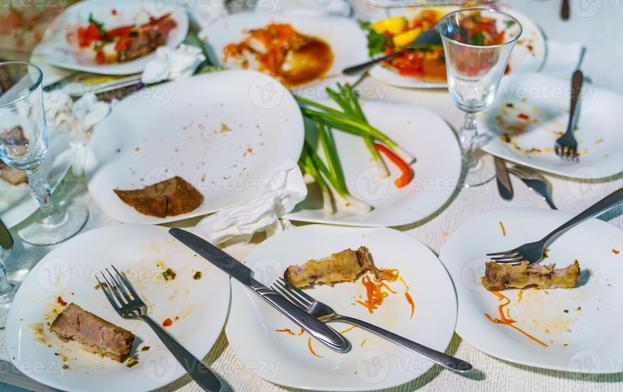
The Dinner Party Where I Served 12 People and Ran Out of Food
I was standing in my kitchen in Charleston at 8:45 PM, holding an empty serving dish, and I realized I had made a terrible mistake. The dish had contained roasted chicken thighs — 12 of them, one per person. Now it contained bones. And my friend Marcus was looking at the empty dish with the expression of a man who had been promised dinner and received a memory.
I am a recipe developer. I have a food blog. I have written cookbooks. I have catered events for 200 people. And I had just run out of food at a dinner party for 12 because I did not scale the recipe correctly.
Here is how it happened. I found a recipe for "Perfect Roasted Chicken Thighs for Four." It called for 4 thighs, 2 pounds of potatoes, 1 pound of green beans, and a sauce made from 1 cup of stock. I needed to serve 12. So I multiplied everything by 3. Twelve thighs. Six pounds of potatoes. Three pounds of green beans. Three cups of stock. Simple math. Third-grade math. Math I had been doing since I was eight years old.
But cooking is not math. Cooking is chemistry. And chemistry does not scale linearly.
The potatoes were the first problem. Six pounds of potatoes in a roasting pan designed for 2 pounds. They were crowded. They were steaming instead of roasting. They were soggy. Not crispy. Not golden. Soggy. Like boiled potatoes that had been left in the oven by mistake. I tasted one. It was edible. It was not good. And there were not enough of them.
Because here is the thing about scaling: 2 pounds of potatoes for 4 people is 8 ounces per person. But 6 pounds of potatoes for 12 people is not 8 ounces per person. Because people do not eat linearly. They eat socially. They take more when there is more. They take less when there is less. And when the potatoes are soggy, they take less. So the 6 pounds of potatoes fed 9 people. Not 12. And Marcus — who was the 10th person to serve himself — got none.
The green beans were worse. Three pounds of green beans in a pot designed for 1 pound. They did not fit. I cooked them in two batches. The first batch was overcooked — I forgot about them while I was dealing with the potatoes. The second batch was undercooked — I was paranoid about overcooking them. Neither batch was good. And combined, they were not enough. Because green beans shrink when you cook them. One pound of raw green beans becomes 8 ounces of cooked green beans. Three pounds becomes 24 ounces. For 12 people, that is 2 ounces per person. That is not a side dish. That is a garnish.
The sauce was the final disaster. One cup of stock reduces to a half-cup of sauce in the original recipe. Three cups of stock does not reduce to 1.5 cups of sauce. It reduces to 1 cup. Because evaporation does not scale linearly. The surface area of the pan does not triple when you triple the liquid. The heat does not triple. The reduction time does not triple. So I had 1 cup of sauce for 12 people. That is 1 tablespoon per person. That is not sauce. That is a drizzle.
By 8:45 PM, the chicken was gone. The potatoes were gone. The green beans were gone. The sauce was gone. And Marcus was still hungry. So was his wife. So was my neighbor from across the street. I had fed 9 people. I had failed 3.
I ordered pizza. I called the local place on King Street. I ordered three large pizzas. I paid $47 for emergency pizza at a dinner party I had spent $120 and six hours preparing. The pizza arrived in 35 minutes. Marcus ate three slices. He said, "This is the best part of the meal." He was joking. I think.
I spent the next week analyzing what went wrong. I read about recipe scaling. I learned about surface area to volume ratios. I learned about heat transfer. I learned about evaporation rates. I learned that doubling a recipe does not mean doubling the cooking time. I learned that tripling a recipe does not mean tripling the pan size. I learned that cooking is math, but it is also physics. And physics has rules.
I developed a scaling system. For every recipe I scale, I adjust three things: ingredients, equipment, and time. Ingredients scale by multiplication, but with a 20% buffer for social eating. Equipment scales by surface area — if the original recipe uses a 9x13 pan, a tripled recipe needs three 9x13 pans, not one giant pan. Time scales by thickness — if the food is the same thickness, the time is the same. If the food is thicker, the time increases. Not linearly. Exponentially.
I tested my system. I made roasted chicken thighs for 12 again. This time, I used three roasting pans. I cooked the potatoes in two batches, spread out, with room to breathe. I blanched the green beans in a stockpot, then shocked them in ice water, then sautéed them in butter. I reduced the sauce in a wide skillet, not a tall pot. I made enough for 15 people. I served 12. Everyone ate. No one went hungry. Marcus had seconds.
I tell this story on my blog. I tell it to my catering clients. I tell it to anyone who asks me about scaling recipes. And I tell them the same thing: cooking is not just math. It is chemistry. It is physics. It is art. And if you treat it like a spreadsheet, you will end up ordering pizza at 9 PM while your guests watch you cry into an empty serving dish.
— Olivia, from Charleston, where the recipes are scaled correctly and the pizza is for dessert.
